
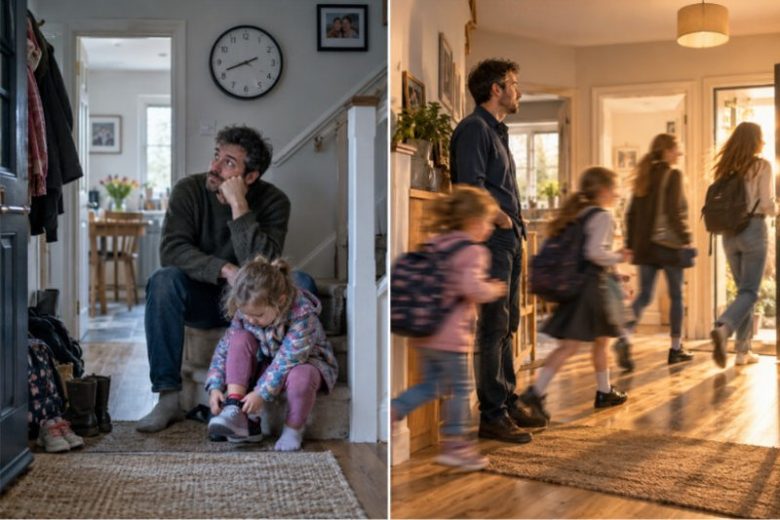
Before becoming a dad, I thought time was dependable. A minute lasted a minute, a year took roughly a year, and Tuesday afternoons were longer than Friday evenings. There were exceptions, such as waiting for a takeaway, but the general system worked.
Then children arrived and time abandoned all known rules.
Fatherhood somehow makes life move at two completely different speeds. Individual days can feel long enough to qualify as geological eras, yet whole years disappear while you are looking for a missing shoe. One minute you are trying to persuade a toddler that trousers are not an attack on his civil liberties. The next, you are putting away clothes he has outgrown and wondering when he became too big for them.
The Longest Five Minutes in Human History
Children can stretch a small amount of time to astonishing proportions. Five minutes before leaving the house is plenty of time for a child to lose a coat, need the toilet, become emotionally attached to a stone and ask why the moon does not fall down.
Bedtime is another area where conventional timekeeping breaks down. An adult hears “bedtime” and imagines teeth, pyjamas, story, sleep. A child hears it as the opening proposal in a lengthy negotiation. Suddenly there are urgent questions to answer, obscure injuries to inspect and glasses of water that must be supplied with the precision of a laboratory experiment.
You can spend an entire evening trying to get a child into bed, only to discover that twenty-three minutes have passed. Alternatively, you can sit beside the bed for “just a minute”, wake up with a stiff neck and realise it is nearly midnight.
Weekends can be slower still. By 9.15 on a Saturday morning, you may have made breakfast twice, cleaned up a spillage, settled a dispute about a cushion and watched enough children’s television to develop strong opinions about its fictional transport infrastructure. You expect lunchtime and find that most sensible adults are only just getting up.
The Years That Vanish

Yet the larger units of time race by. The sleepless newborn stage feels endless while you are inside it, but later it contracts into a handful of blurred memories: tiny clothes, cold cups of tea and pacing the landing at an hour when only delivery drivers and foxes appear to be awake.
The same thing happens with every phase. There is a period when you believe you will spend the rest of your life cutting grapes in half. Then, without any announcement, you stop. The stair gate comes down. The pushchair leaves the hallway. Nobody asks you to perform a particular silly voice during a story. These changes rarely feel important on the day they happen because you do not know you are doing something for the last time.
That is one of fatherhood’s quieter tricks. Firsts receive photographs, messages and enthusiastic applause. Lasts tend to slip past unnoticed. There is a final time your child falls asleep on your chest, but nobody tells you to pay attention. One day you simply realise it has not happened for a while and probably will not happen again.
It is sad, although not necessarily tragic. Children are supposed to grow. A dad’s job is not to preserve every stage like an exhibition in a museum. Besides, some phases deserve to end. I have never met a parent who watched the final nappy disappear and whispered, “They grow up so fast,” while fighting back tears.
Living by Phases Instead of Dates
Before children, memories often attach themselves to years. You remember the year you changed jobs, moved house or went on a particular holiday. Once you become a parent, life is divided differently: the dinosaur phase, the year of the yellow wellies, the summer when every stick had to come home with you.
These periods feel permanent until they are replaced. A favourite toy becomes an essential companion. Its disappearance triggers a household emergency involving torches, accusations and a search beneath the sofa. Six months later, you find it in a box and your child barely remembers its name.
Parents change during these phases too. At first, you measure success in hours slept and whether everyone has eaten. Later, you worry about friendships, confidence, school and how much independence to allow. The practical work becomes easier in some ways, but the questions become harder. You no longer need to stop them putting a building block in their mouth; you have to help them cope when somebody says something cruel.
There is rarely a moment when you feel that you have mastered the job. Just as you become reasonably competent at parenting the child in front of you, that child changes. It is like revising diligently for an exam only to discover that the subject has been replaced overnight.
Why Ordinary Time Matters

This strange relationship with time creates pressure to make every moment count. Parents are reminded that childhood is short, usually while tired, late and scraping dried cereal from an object that should not contain cereal.
But making time count does not mean making it impressive. Children are unlikely to remember every carefully planned outing. They may remember the joke that made everyone laugh in the car, being allowed to stay up slightly late or the evening a simple game became unexpectedly competitive.
Much of family life is repetition: packed lunches, school runs, bath times, lost belongings and requests for snacks immediately after meals. It can feel mundane because it is mundane. That does not make it empty. Familiar routines are often what make childhood feel safe, even if nobody expresses gratitude while being told for the fourth time to put on their socks.
Fatherhood makes time feel slower because children demand that you live through so many small moments in full. It makes time feel faster because those moments accumulate into years before you notice.
There is no clever way to stop that. You cannot appreciate every second, and anyone who claims otherwise has never supervised a child with a stomach bug. The best you can do is notice some of it: the phrases they mispronounce, the questions they ask, the temporary obsessions and the hand that still reaches for yours without thinking.
The days will occasionally drag. The years will continue to sprint. Somewhere between the two is family life: exhausting, funny, repetitive and gone more quickly than seems reasonable.