
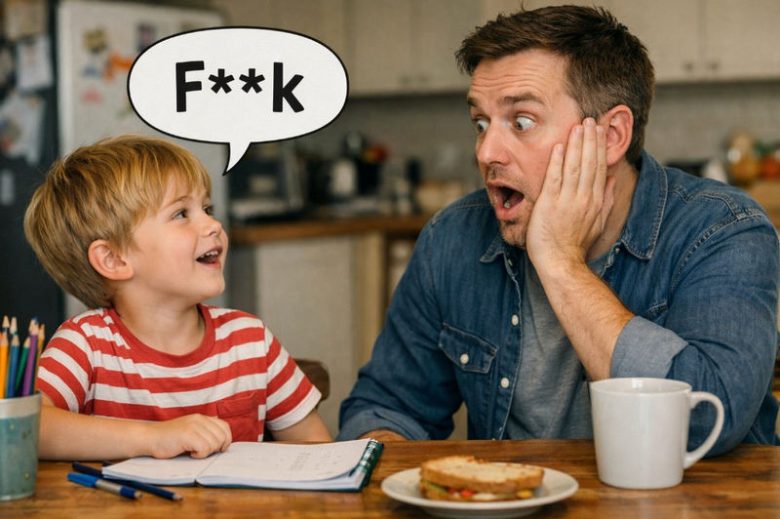
One of the strange things about parenting is how many milestones nobody really warns you about. The first day of school? You expect that. The first time they ride a bike? Sure. Even the first argument about bedtime eventually comes along.
But the first time your child comes home casually dropping a word you absolutely did not teach them? That one can catch you completely off guard.
For a lot of dads, it goes something like this. You’re sitting at the dinner table or driving home from school and suddenly a perfectly innocent sentence includes a word that makes you choke on your tea.
“Where on earth did you hear that?”
The answer, nine times out of ten, is the same: school.
It’s one of those moments when you realise your child is now fully exposed to the outside world, with all the good and bad that comes with it.
And while it might feel alarming at first, it’s actually a very normal part of growing up.
Why Kids Pick Up Swearing So Quickly
Children are extremely good at picking up language. Much better than adults, in fact.
That’s partly because they’re constantly listening and copying the people around them. Language is how kids figure out the world, so anything that gets a reaction tends to stick.
Swear words tick all the boxes.
- They’re emotional.
- They’re memorable.
- And most importantly, they cause a reaction.
Even if a child hears the word just once, they often notice the tone and the response around it. If another kid says something and everyone laughs or gasps, that word suddenly becomes very interesting.
Schools are obviously full of different children from different homes, and some kids will have heard language that others haven’t. Once a few words start circulating around the playground, they spread quickly.
It’s not usually about being naughty. More often it’s curiosity and experimentation.
Kids are trying out new words to see what they mean and what effect they have.
The Playground Language Exchange

One thing most parents eventually realise is that schools are basically giant language laboratories.
Every playground has that one kid who seems to know words nobody else has heard yet. They pass them on to friends, who pass them on again, and suddenly the entire class is experimenting with a brand new piece of vocabulary.
Most of the time, the kids don’t even fully understand what they’re saying.
They just know it sounds grown-up or rebellious.
I remember hearing my own child confidently repeat a word they’d clearly picked up from somewhere. When I asked what they thought it meant, the answer was essentially a shrug followed by “I don’t know… it’s just a word.”
That’s very typical.
Swearing, at least in the early stages, is usually more about curiosity than defiance.
Why Kids Often Test It At Home
Once a child learns a new swear word, there’s a good chance it will eventually be tested out at home.
Parents are the safest audience for experimentation.
Kids are trying to figure out the rules of language, and that includes working out which words are acceptable and which ones cross a line.
Sometimes it slips out accidentally. Other times it’s a deliberate test.
You’ll see the look on their face when they say it. That tiny pause afterwards where they’re waiting to see how you react.
And that reaction matters more than you might think.
The Worst Thing You Can Do

It’s very tempting to react dramatically when you hear your child swear for the first time.
Shouting, overreacting, or turning it into a huge confrontation is understandable. After all, nobody wants their child wandering around the playground sounding like a drunken football fan.
But big reactions can sometimes backfire.
Remember that kids often repeat words precisely because they get attention. If a particular word causes an explosion at the dinner table, it instantly becomes more interesting.
That doesn’t mean you ignore it. But it does mean staying calm helps.
A steady response usually teaches the lesson far more effectively than a dramatic one.
Start With A Simple Explanation
One of the most useful things you can do is simply explain that some words are considered rude.
Children don’t automatically understand the social rules around language. They need those rules explained in clear, simple terms.
Something along the lines of:
“That word is something some adults say when they’re angry, but it’s not a word children should use.”
You don’t need to deliver a lecture about morality or punishment. Most of the time, a calm explanation is enough for younger kids.
They’re often surprised to learn that the word carries that kind of weight.
Help Them Understand Context
As children get older, the conversation can become a little more nuanced.
The truth is that swearing does exist in the adult world. Kids hear it in films, on television, in sports stadiums, and sometimes from grown-ups themselves.
Pretending it never exists usually doesn’t work.
Instead, it can help to explain that certain words are considered inappropriate in certain places.
School, for example, has rules about language because it needs to be a respectful environment for everyone.
This approach teaches something far more valuable than just “don’t say that word”.
It teaches social awareness.
Look At Your Own Language Too

This is the slightly uncomfortable part for many dads.
Kids are incredibly good at noticing what we say, not just what we tell them to say.
If we regularly shout colourful language at the television during a football match, it shouldn’t come as a huge surprise when those same words appear a few weeks later in the playground.
That doesn’t mean parents have to speak like Victorian schoolteachers all the time.
But it’s worth remembering that children absorb far more than we realise.
Sometimes the easiest way to shape their language is to quietly adjust our own.
What Schools Usually Do About It
Most schools deal with swearing in fairly predictable ways.
Teachers understand that children often repeat words without fully understanding them. The usual response is a reminder about school rules and, if it continues, a conversation about respectful language.
In more serious cases, schools may involve parents, particularly if the language is directed at other children or staff.
But the vast majority of playground swearing incidents are minor and short-lived.
Kids experiment with words, realise they get into trouble for them, and eventually move on.
A Phase Most Kids Grow Out Of
For many families, the swearing phase turns out to be brief.
Once children understand that certain words aren’t acceptable at school or at home, they usually drop them pretty quickly.
The novelty wears off.
Something else becomes the new playground trend instead.
Looking back, most dads end up realising that the first swear word wasn’t a sign of terrible behaviour or bad influences. It was simply another step in their child figuring out language, boundaries, and the social rules of the world around them.
And if you handle it calmly, with a bit of explanation and a bit of patience, it usually becomes just another funny parenting memory.
One day you’ll probably even laugh about it.
Preferably not while your child is within earshot.